1 Nephi 1: 1, 3
...therefore I make a record of my proceedings in my days. And I know that the record which I make is true; and I make it with mine own hand; and I make it according to my knowledge.

^^That pretty much explains this blog.
Showing posts with label Revolutionary War. Show all posts

Friday, October 28, 2016

Benjamin Lemaster, Revolutionary War Hero, Part IV

Please begin reading this four-part chronicle HERE.     


     I’ve taken most of my information in this four-part saga from Benjamin Lemasters and the American War for Independence, by Agnes McNeill, via Katherine LeMaster Dendy. Some information came from Wikipedia and other web sites. I’ve given credit to photos when it was available.

     As I said before, I will be forever grateful that I took the time to pursue my family history while my children were young—and not save it for retirement. Most of the people from whom I gathered so much information—on both sides of my family tree—are no longer with us: my dear grandmothers, my great aunt Kitty, my cousin Kent Kessler and all my West Virginia cousins who are now in heaven having reunions without me.

     I also have living cousins who have given me enormous bounties of information on this line: Karen “Kandy” Kessler Cottrill, and Judi Spencer, James Lewis Ball. At one time, when email was new and the internet wasn’t invented, we exchanged thousands of emails on our research. Yes, thousands. Good times.

     And thank goodness for the internet. When I started doing my research back in the late 1970s, there were no computers—just libraries and hard copies from a Xerox machine.

     After spending some time in New Orleans and gleaning information from my father’s first cousins, and my second cousins, we purchased a computer in about 1994. What had taken me three weeks to “fill in the blanks” by hand on pedigree charts after that trip, took me 30 minutes on the computer. That’s progress!

     When I returned to New Orleans in 2001, when the World Wide Web was still young, I spent a week sitting in the New Orleans Library, twirling the handles of microfilm readers until my shoulders ached. Now, most of that information is on the internet.

     I am thankful for my kissin’ cousins who have spent entire lifetimes gathering this information about Benjamin Lemaster(s) for me. There are many, many of my cousins, far and wide, who have used this patriot to join the DAR (Daughters of the American Revolution).

     I visited the DAR headquarters in Washington, D.C. in about 2006. It’s a beautiful building full of books, documents, photos, and letters. I would like to join that community. Maybe I’ll save that for when I retire.

     This is the last segment I will pursue on Benjamin Lemaster. Be proud if he is your ancestor. I know I am.


CHRONOLOGY OF THE REVOLUTIONARY WAR SERVICE 
__________OF BENJAMIN LEMASTER__________
PART IV
1778-1779

Washington Rallying the Troops at Monmouth
by Emanuel Gottlieb Leutze
June 28, 1778: Battle of Monmouth Court House, New Jersey
       
     Prelude to Battle: To be brief and not tell the whole story, suffice it to say, once they learned of the French helping the Americans, the British decided to leave Philadelphia for New York, and possibly flee to Quebec. They were going to take ships down the Delaware Bay and up to New York, but the Loyalists in the city heard they were leaving and demanded they take them with them.

     The Loyalists/Tories took up all the room in the ships, so the British soldiers were left to hoof it through New Jersey to New York, under the command of Sir Henry Clinton, who replaced William Howe in May 1778.

     The evacuation began June 18, 1778. Little did Clinton know that Washington’s new and improved troops, fresh from Valley Forge with new recruits, pursued a parallel path through New Jersey, waiting for a time to strike.

     Washington sent Charles Lee, only recently exchanged after a winter of captivity in New York, to head up the 5,000 men to provoke the British. The First Virginia Regiment was with them. On June 28, the British launched the attack, focusing on the left wing under the command of Major General William “Lord Stirling” Alexander.

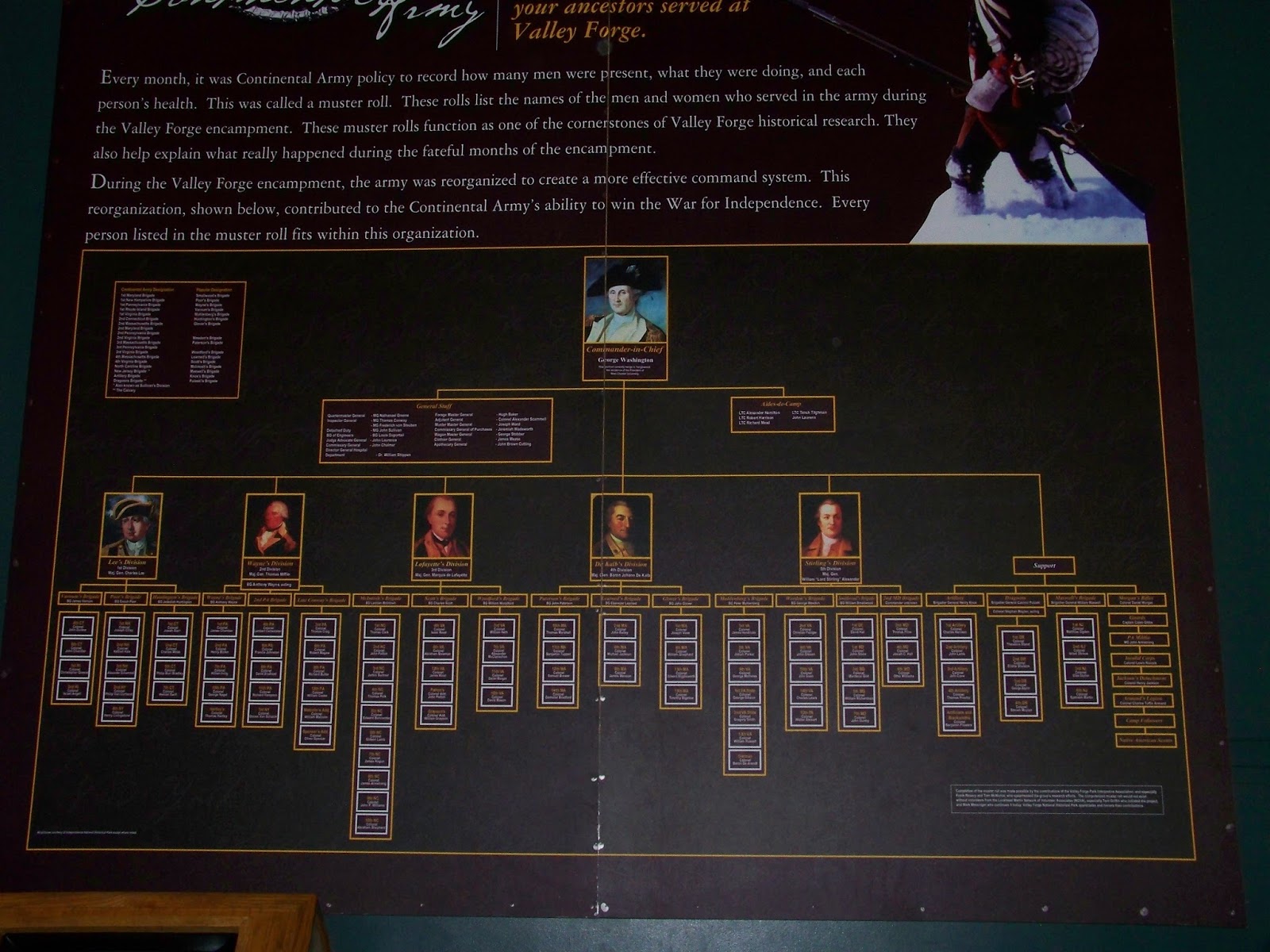
     If you remember the photos of the organization chart from the Valley Forge Visitor Center, Lord Stirling was the head honcho reporting to Washington, and our Benjamin served under Brigadier General Peter Muhlenberg, who served directly under Lord Stirling. BUT Benjamin’s regiment, under Colonel Richard Parker, were in the Advance Guard—the Right Wing. (https://en.wikipedia.org/wiki/Monmouth_order_of_battle)

     To make a long story short, after doing some battle, and with his men dropping from "fatigue," Lee ordered a retreat and the men landed in the lap of Washington, who sent them all back to the battlefield. Washington was so enraged, it’s reported he actually cursed at the general in public, something he rarely did. He also dismissed Lee from the battlefield.

You can see where Lee charged into the battle, then his retreat, right into the path of George Washington.

     Lee was eventually court martialed and never led another unit. Read more about this HERE

     The temperatures on June 28, 1779 were in the 100s, so you can bet the humidity was probably in the 80s or 90s. Many men on both sides suffered from heat stroke—37 Americans died of "fatigue." This severely impacted both armies—the British lost 59 to heat stroke. The Americans, plagued by the hottest time of the day—could not pursue the fleeing British.

     By twilight, the British had all withdrawn from the battlefield. In fact, they withdrew from the whole area during the night. Washington chose not to follow them, probably because of the fatigue of his men.

     Having just spent the winter at Valley Forge, though, the Americans were renewed by this engagement, even though the battle was a draw (neither side gained the field of battle). Even so, both sides claimed victory.

     Although the war would last five more years, this was the last engagement between two full armies ever fought during this war. It was considered the last battle of the northern theater.

M'r Capitaine du Chesnoy, A.d.C. du Général LaFayette. - Library of Congress
Map of the Battle of Monmouth Courthouse, N.J.
Public domain
     As an aside, this is the battle of “Molly Pitcher” fame. Learn about that HERE.  
Molly Pitcher


June-July 1778: Hospitals in Brunswick, NJ and White Plains, NY
     It appears Benjamin Lemaster was one of the unfortunate victims of heat stroke. In those days, without “air conditioning,” it was very difficult to cool down a body during heat stroke, especially in 100-degree weather, other than cool baths, and ice, if you could get it. Symptoms include confusion, agitation, slurred speech, delirium, seizures, coma, nausea and vomiting, flushed skin, rapid breathing, racing heart rate, throbbing headache. Ugh.

     According to his muster roll for the month of July 1778, Benjamin Lemaster spent time in the hospital at Brunswick, NJ, then a flying hospital at White Plains where his regiment removed, and where he first began his service in the war, if you remember.

     By August, he stood guard duty at White Plains. In September, he was stationed at Camp Robinson in NY “on command.” From October through December he suffered through another winter camp at Middle Brook, NJ, then ended up sick again at Brunswick in January 1779.

     He began the spring of 1779 on lookout duty at Sandy Hook, NJ. Sandy Hook is an elongated sand bar attached to the New Jersey coast and which jutted directly north into Lower New York Bay. The southern tip of Long Island and the Verrazano Narrows were visible from Sandy Hook. Washington posted lookouts here to keep him apprised of the movement of British ships into and out of New York harbor.
Sandy Hook, NJ, across the Jamaica Bay from New York.

     This last assignment must have been boring. During his stint at Sandy Hook, Benjamin Lemaster had nothing to report. Little did Washington know, the British abandoned the plan to go north and were gearing up for battle in the south.

May 7, 1779: Last Muster Roll
     Benjamin Lemaster drew pay on 7 May 1779 for service in the month of April at Sandy Hook, the last muster roll on which he appears as a member of the First Virginia Regiment.   

     According to his Pension Statement, he took a furlough to go home and get married. While home, he said the battle of Yorktown took place, so he never returned to duty. His memory was a little foggy because the Battle of Yorktown took place in October 1781. His two years were up in April 1779, so that’s probably why he didn’t return. He had served two years, four months, and two weeks.

     By the time he gave his first pension statement in 1832, he was 76 years old. He couldn’t remember the order of the battles—and who can blame him? He participated in so many, he must have been addled just a little bit. 

     The pensions were supposed to be given to men who fought in the war and were now destitute. Benjamin sought a pension in 1832 because, before that, he owned too much property or land to qualify. He was granted the pension in 1833, retroactive to 4 March 1831. Fifty-seven years had passed since his original three-month enlistment in September 1776.

     He had to testify again in 1835 because his 1832 testimony didn't add up. Though Agnes McNeill wrote that his $80 per annum pension was reinstated, I have found no evidence of this. The poor man died in 1837.

     Read part of his Pension Statement HERE

     I have more information about Benjamin, but I decided only to write about his Revolutionary War experiences. I urge you to go online and find what you can about the war and the engagements in which he fought.

     This is only one of many of our ancestors in Grandmother Mary Lou’s lineage who fought in the Revolutionary War. Be very proud of your heritage. It is noble.

     Please visit this YouTube channel to see the homestead gravesite of Benjamin Lemaster and his wife, Rebecca Ann Martin Lemaster.
Benjamin Lemaster gravesite, and homestead in Bucks Garden, Summersville, Nicholas County, WV 

     I visited many family plots like this throughout West Virginia in the summer of 2006, when our cousin, James Lewis Ball, graciously escorted me all around creation in the heat of the summer. I was in my glory. J

     We descend from their second of 10 daughters, Mary “Polly” Lemasters, who married James Clendenin Boggs, son of Francis Charles Boggs (born in Chester County, PA, near Doe Run), who also fought in the Revolutionary War. But that’s another story.


You’re welcome!


Monday, October 24, 2016

Benjamin Lemaster: Revolutionary War Hero, Part III: Valley Forge


Please begin reading this chronicle HERE.

All photos of Valley Forge in this blog post were taken by Susan Knight, except for the photo of Washington's Headquarters. They may be shared, with credit, but not sold. Click on them to enlarge.


CHRONOLOGY OF THE REVOLUTIONARY WAR SERVICE 
__________OF BENJAMIN LEMASTER__________
PART III
Valley Forge, 1777-1778 

Benjamin Lemaster suffered in Valley Forge along with four thousand fellow volunteers. He had seen many battles since he joined the war effort in September 1776. 


Command of the court-martialed Stephen’s division was turned over to Peter Muhlenberg, a Lutheran minister from Woodstock, Shenandoah County, Virginia. The First, Fifth, Ninth and Thirteenth Virginia regiments were assigned to Muhlenberg, along with the First and Second Virginia State Regiments and a German Regiment.
       
        The First Virginia was placed under the command of Colonel Richard Parker. Benjamin Lemaster served under Parker for the duration of his service in the army.


The First Virginia Regiment was part of Muhlenberg’s Brigade under Lord Stirling’s Division and entered Valley Forge with 237 men, 94 fit for duty. It left Valley Forge with 507 men and 281 fit for duty.


And, serendipity for the Lemaster brothers, Benjamin's brother Joseph, in the 13th Virginia Regiment, was also assigned to Muhlenberg's Brigade. They got to see each other every day (I assume). It is sweet to think that the two "boys," ages 21 and 19, dealt with the harsh winter together, no doubt buoying up each other in the crisis, sharing letters from home, and reminiscing of their life in Maryland and Virginia before the war. 


Joseph Lemaster's son, John Waddell Lemaster, named his first son Marcus Lafayette Lemaster (a play on Marquis perhaps?), which makes me wonder how many times he heard his father tell stories about being in the company of the Marquis de Lafayette. Lafayette was only 19 years old himself in 1777, like Joseph Lemaster, when he joined with Washingtonas a volunteer Major General (?!?). He also fought in the Battle of Brandywine along with the Lemaster boys. You can read more about this amazing young man, who considered George Washington his adopted father, HERE


Joseph Lemaster's regiment left Valley Forge in May 1778 and headed west for Pittsburgh. The boys would meet again when they both mustered out of the army, Benjamin in 1779 and Joseph in 1780.

I visited Valley Forge in 2010 before I moved west. I was told by the park rangers that the winter of 1777-78 was not bitter cold like 1776 and, in fact, many died from disease due to the milder temperatures—in the 40s—making Valley Forge very muddy which was the scourge of the camp.


As the result of this mild winter, the most common killers in camp were influenza, typhoid, pneumonia, dysentery, and typhus.


The Pennsylvania winter, with freezing, thawing, and freezing again, and the light snow which gave little snow melt for water, caused waves of illness and many deaths. Most men died during the warmer months from March to May. An inoculation program, and camp sanitation, eventually helped limit the death tolls.


Discouraged soldiers deserted in great numbers. Mutiny was feared. All Washington had to do was mention that he would “retire” to his plantation and all murmuring would stop.


Though many soldiers had a full uniform, shortages of clothing did cause severe hardship for a number of the men. I often wonder if my Benjamin suffered due to lack of clothing and shoes. After all, he came to the war with only the clothes on his back and his musket (or rifle—whichever he had).

Only a muslin shirt.
I wonder if this is what Benjamin wore,
or if he was lucky enough to have a wool coat like the man behind this one.
The soldiers built log cabins under General Washington’s precise instructions—14 x 16 feet, 6-1/2 feet high, a door next to the street and a fireplace in the rear. Since most of the men were not skilled craftsman—and one man complained of having a dull ax—there were some personalizations that went on as men from different regions had differing techniques for building.

Hut at Muhlenberg encampment at present-day Valley Forge, Pennsylvania

“And as an encouragement to industry and art, the General promises to reward the party in each regiment, which finishes their hut in the quickest, and most workmanlike manner, with twelve dollars.”  --General orders, December 18, 1777
The first hut appeared in three days. (https://en.wikipedia.org/wiki/Valley_Forge)
By mid-January, most soldiers were housed, twelve to a hut. (http://valleyforgemusterroll.org/encampment.asp)

Hut at present-day Muhlenberg encampment where the reenactments take place.
This is the inside of an officer's hut. It only has one bed.
Perhaps the Marquis de Lafayette had a hut like this.
He insisted on living in the midst of his men.


This hut holds 12 people--4 bunks in each quarter
I call top!
Inside an enlisted men's cabin. How cozy.
-12 bunks-
-A fireplace-
-Playing cards-
-What more does a man need?-
Maybe food and clothing . . .
Over 2,000 log cabins and huts were built as well as a bridge over the Schuylkill. Because the weather was mild, the men were able to construct all they needed, and supplies were available. Being a greatly forested area, there was plenty of timber for the log cabins.


When I was there in 2010, I saw an earthen oven in the Muhlenberg encampment where the park ranger said they made their daily bread. Coals were spread along the ground for cooking purposes. Though they probably had to keep with their own regiments, I imagine to myself the two brothers making and breaking bread together.


The park ranger told me, as soon as Nathaniel Greene was appointed Quartermaster General, supplies were found and shipped down the Schuylkill from Reading and brought in from nearby farms. There was a forge on the property where they could attend to their weapons and wagons.


Those in camp came from all thirteen of the original states. Men, women and children, all different ethnicities and religions came together at Valley Forge. Women helped immensely with laundry, mending, cooking, and nursing the sick men.


As part of Benjamin Lemaster’s Pension Statement, in 1835, an Andrew P. Friend swore before the Justice of the Peace in support of his pension as a “Revolution soldier of the United States.” According to Friend’s best recollection: “. . . he knew the said Benjamin Lamasters of Nicholas County to have been in the army that he the said [Peter] McCune & Benjamin Lamaster had both their washing done By one Woman for some time.”


Women and children, who made up the “camp followers,” suffered the deprivations along with the soldiers. Women got half pay (half of what the soldiers received) and children, if they worked hard, got quarter pay.
Yes, even cute little boys like this served at Valley Forge.
This little guy is only 10 years old.
The best thing to happen to the camp was when Prussian Army Officer Baron Friedrich von Steuben arrived in February 1778. He wipped the army into shape and taught them how to be soldiers—the first training they had on the matter.

It took really long to load and fire. I was really surprised.
They only got one shot, then had to reload again.
May 6, 1778--the army celebrated France’s alliance with the formally-recognized United States, and whose arrival triggered the evacuation of the British troops from Philadelphia in June. (http://valleyforgemusterroll.org/encampment.asp)


June 15, 1778--Benjamin Lemaster turned twenty-two years old as they prepared to leave Valley Forge.


June 19, 1778--Washington’s men marched from Valley Forge to Philadelphia and retook the city. By the Battle of Monmouth, nine days later, the army demonstrated a more mature and improved expertise on the field of battle. Victory achieved.


I was able to look up Sergeant Lemaster on the computer at the Valley Forge Visitor Center and noted he was in the Muhlenberg regiment—the exact place where they have cabins to show tourists what it was like, and where they have their reenactments. It was the first area near the visitor’s center. Serendipity.


First Virginia Regiment, under Colonel James Hendricks.
In the history I have, it says he served under Colonel Parker, so I'm not sure
how the regiments were broken up. Some research for another day.

As you drive around the park, you will see various monuments
erected by the States whose soldiery participated at Valley Forge.
This is the Virginia monument.
Click on it to enlarge.

Even though I knew the cabins were only replicas of where they actually lived, just walking the hallowed grounds gave me chills. 


Seeing Washington’s headquarters made my soul swell with pride.  My Benjamin Lemaster served with George Washington in almost all the campaigns while enlisted in the fighting.


Washington's Headquarters in the bottom of the valley.
(This is the only photo I took from the internet.
I couldn't believe I failed to get a photo of the front of the house.
It isn't hard to envision the hubbub that took place in this room every day.

Martha Washington was here too.
          (And I have a table cloth made of that same blue material.)

Martha, as hostess, oversaw the kitchen, the food preparation, and the guests.
I'm sure she was a great comfort to her husband as well.
In the breezeway. Original.
View from the back of the big brownstone house.
There were 2,000 log cabins built all over the acreage.

           
             Everywhere I drove, I saw cabins tucked in the woods, each one representing hundreds of others, I imagine.
                                                                                                                                              
I also saw a few small herds of deer as I drove around.
At any time, Washington expected General Howe to march to Mount Joy, the top of the encampment, and overtake his men at Valley Forge. A redoubt was built and cannons were aimed at the city, a little more than 25 miles away.
The British never did leave the city.

This cannon, near the top of Mt. Joy, is still aimed at Philadelphia, 25 miles away.

End of Part III

Monday, September 12, 2016

Benjamin Lemaster, Revolutionary War Hero, Part II

Please begin by reading Part I HERE

CHRONOLOGY OF THE REVOLUTIONARY WAR SERVICE 
__________OF BENJAMIN LEMASTER__________
PART II
1777 


This equestrian statue of George Washington at Washington Circle in Washington, D.C. depicts him at the Battle of Princeton. Sculptor Clark Mills said in his speech at the statue's dedication ceremony on February 22, 1860, "The incident selected for representation of this statue was at the battle of Princeton where Washington, after several ineffectual attempts to rally his troops, advanced so near the enemy’s lines that his horse refused to go further, but stood and trembled while the brave rider sat undaunted with reins in hand. But while his noble horse is represented thus terror stricken, the dauntless hero is calm and dignified, ever believing himself the instrument in the hand of Providence to work out the great problem of liberty." (https://en.wikipedia.org/wiki/Battle_of_Princeton)
January 3, 1777: Battle of Princeton. Benjamin Lemaster is wounded.
          The fact that Benjamin Lemaster participated in this battle, proves that he did become one of the "six-weeks men" of George Washington's impassioned plea. 

          Two First Virginia companies, under the command of John Fleming, formed part of a detachment led by Hugh Mercer and were the first troops to make contact with the British. The Americans were doing well in a volley and they were backed up by two canister-firing field pieces which kept the British at a standstill. 

          Suddenly, in one of those quirks of battle, Mercer’s riflemen and his artillery had to pause to reload at the same time. [Yikes!] The British ordered a charge with bayonets—and they were wielded with ferocity.

          Mercer's men were put to flight. [Another retreat?] Mercer was bayoneted as he tried to fight with his sword. The British soldiers thought he was Washington! Mercer died several days later from these wounds.

          Captain Fleming was shot through the head at almost point-blank range. The ranks broke and began running, the British firing wildly while rushing with bayonets. An artillery captain named Joseph Moulder had managed to get his two cannons to the top of the hill overlooking the orchard where the fighting took place. He loaded both with grapeshot and trained them on the charging red-coated regiment.

          Just as Moulder gave the order to fire, Benjamin Lemaster was hit in the ankle by a shot from a British Brown Bess musket. He got to his feet and hobbled away just as Washington arrived on the scene with the Virginia Continentals and Edward Hand’s riflemen. Daniel Hitchcock’s New England Continentals also charged in and were put to the fight as well.


Both British and Americans were given the order to fire, obscuring the field in a cloud of smoke (https://en.wikipedia.org/wiki/Battle_of_Princeton). Dozens of musket balls whistled past George Washington. When the smoke cleared, neither he, nor his white charger, were hit. Turning the tables, his soldiers now pursued the fleeing British. No retreat this time!

I am in awe that my ancestor was a witness to the Divine protection offered to Washington throughout his military career. Many stories were told of his Providential survival.

        Benjamin was taken to a makeshift emergency field hospital, his wound examined, and temporarily bandaged. Someone found Fleming’s horse wandering the battlefield, so it was loaned to Benjamin to enable him to catch up with the army as Washington marched on to Morristown, New Jersey. 
        
        I can't imagine how Benjamin felt, riding his mortally-wounded commander's horse, his ankle mangled by the musket ball, yet forging onward to be with his comrades. 


With their third defeat in ten days, the British evacuated southern New Jersey. Morale rose in the American ranks and more men began to enlist in the army.

        Sometime after this, Benjamin went to a hospital in Philadelphia to have his wound treated properly. He then returned to headquarters at Morristown for winter encampment.
           
          In his Pension Statement, Benjamin wrote: “I was at the Battles of Monmouth & Princeton—at the latter engagement I was wounded in the right ancle—with a Musket Ball. was sent to the Hospital at Philadelphia and was there inoculated for the small Pox.”


           According to Agnes McNeill in "Benjamin Lemasters and the American War for Independence," it was a remarkable stroke of luck that Benjamin Lemaster was sent to a hospital in Philadelphia rather than the "Flying Hospital" which accompanied the  Continental  Army on its campaigns. Those medical facilities were usually ill-equipped to handle even what we would consider the most minor of injuries. 

          "The  major solution to most wounds was amputation, and excessive loss of blood and infection from unsanitary conditions caused a high percentage of hospital deaths. Even the slightest of wounds could sometimes be 'treated' into a fatal ailment by the inadequate methods of the time." (Agnes McNeill)
          
          The fact that he was sent to a hospital in Philadelphia leads me to believe his ankle injury was more serious than even Benjamin Lemaster portrayed it in his pension statement. Bless his good fortune to be sent to Philadelphia. He was my ancestor. I wouldn't be the same person without him in my tree.

The Death of General Mercer at the Battle of Princeton

 February-April 1777: Guard duty at Trenton under Capt. Kilpatrick


Washington and the Continental Army made winter camp near Morristown, New Jersey from January to May 1777. Washington’s headquarters was at Jacob Arnold’s Tavern in the center of town. Morristown was selected as a strategic location between Philadelphia and New York City, as well as the skill of its tradesmen, natural resources and the ability to provide food to the troops. Its churches were used as a base for inoculations for smallpox. Morristown was also the site of a second winter encampment in 1779.
          
       Benjamin must have hero-worshiped George Washington—just guessing here. Rumors circulated the colonies about Washington withstanding gunfire in previous wars and battles with nary a wound—but his coat shot up with holes. Benjamin stood as a witness to this at Princeton. He re-enlisted in March 1777 for two more years in William Lewis’s company. 

May 1777: Promoted to Sergeant
          Attesting to Benjamin's good behavior and skill, he was promoted to Sergeant in Captain William Lewis’s company of the First Virginia Regiment. He held this rank for the duration of his service.

June 15, 1777: Benjamin Lemaster turned twenty-one years old this day.

August 1777: Philadelphia March
          Benjamin Lemaster and his First Virginia marched triumphantly through Philadelphia, the new capital, on August 24, 1777. Washington hoped this parade of the Continental Army might send a message to the Loyalists in the city. They then moved south on their way to the head of the Chesapeake Bay on August 25, in order to protect the city from capture. 


September 1777: The Battle of Brandywine
          [Benjamin’s brother Joseph also fought in this battle, as well as The Battle of Germantown which followed.]
          Washington established a complicated line of defense around the Brandywine Creek at Chadd's Ford [of Andrew Wyeth fame], Delaware County, just north of the Pennsylvania-Delaware border. Washington's plan of battle was elaborate and complex. Unfortunately, nearly everything which could have gone wrong, did. The Battle of Brandywine Creek, on September 11, turned into another disheartening defeat.
         
          Alas, the British forces were strong18,000 British troops to 11,000 Continentalsand, after many casualties on both sides, the Continentals were forced to pull back toward Philadelphia through Chester, and then north to Germantown.

          Washington kept his sights on General Howe, who moved from Reading, then toward Philadelphia, then toward Wilmington. On September 15, he settled on West Chester [about 10 miles from where I grew up] and prepped for battle. 

          Washington’s Army outnumbered Howe’s, so he felt assured of a victory. A torrential downpour on September 16 stifled the presumptive “Battle of West Chester." [It was rained out!] Both armies suffered losses of about a half-million cartridges. Fighting stopped for several days.

          Washington’s Army withdrew to Yellow Springs [where my brother, John, and his wife, Pam, lived when they first got married]. George Washington thought Howe would try to get back to Reading, so he moved his Army to Pennypacker’s Mill on the Reading Road [which, I believe is Route 73. Pennypacker's Mill is located just off Route 73 today on Haldeman Road. I taught a Scherenschnitte class there many years ago.]

          Meanwhile . . . at ten o'clock p.m. on September 20, General Anthony Wayne and his Pennsylvania Regiments were surprised by the British at their camp near the General Paoli Tavern. The Battle of Paoli was fought with another loss for our side.
          
       [Having grown up and lived in this part of Pennsylvania, I marvel at the amount of miles these troops covered--and on foot. It takes over an hour by car to travel from Yellow Springs to Pennypacker's Mill today.]

          On September 26, almost as an afterthought, Cornwallis led a detachment of grenadiers into Philadelphia and announced that he had captured the city. The Congress fled first to Lancaster, then to York [and I think they took the Liberty Bell with them]. The British took control of the city of Philadelphia without opposition.

The Battle of Brandywine-Chadd's Ford

October 4, 1777: Battle of Germantown 
          On October 2, Washington moved his Army to Center Point, and at twilight, the evening of October 3, 11,000 men moved toward Germantown.

          Benjamin Lemaster, his shoes probably worn through with three weeks of constant marching, trekked along once again under the command of Adam Stephen. A dense fog hung over the Schuylkill River [pronounced "Skookle"] at dawn on October 4. By six o'clock, they made contact with a British outpost at Mt. Airy.  The Battle of Germantown had begun.

          Benjamin Lemaster was there for the crazy chaos that ensued.

          Stephen’s division got hopelessly lost in the fog and got separated from the other divisions. He heard firing and the division turned toward the sound of the guns. The fog was made worse now by the addition of the smoke of battle. The firing, they came to find out, was from William “Scotch Willie” Maxell’s division, held up by a small group of red coats in the home of Benjamin Chew, a noted Philadelphia Loyalist. He tried to overcome the Chew house, but to no avail. A heavy stone manor, the Chew House proved almost impervious to cannon attack.

          Other battles ensued and it didn’t look good for our side. Our men had to fight harder to retreat than they had fought to move forward.

          Meanwhile, Stephen’s division, with our Benjamin Lemaster, spied some “blue coats” in the fog. Someone shouted “Hessians!” and they fired into the backs of the men in front of them, which turned out to be Anthony Wayne’s men. They all thought the British were pursuing them and made a mass exodus through the fog, colliding with Maxwell’s men fighting to overcome the Chew house.

          Both sides ran for their lives in opposite directions, our men not realizing their victory. Anthony Wayne was close to resigning his command when he saw the incredible spectacle before him—Adam Stephen lying on the ground, drunk. Washington could not believe his eyes at the debacle and utter chaos. He could only order a general retreat. 

           The British withdrew to Philadelphia.

The Battle of Germantown, attack on Chew's House
Johnson, Fry & Co. Publishers, 1860
   
October 23 to November 15, 1777: The Battle of Fort Mifflin
          After the Battle of Germantown, Washington moved his headquarters to Whitemarsh, along the Wissahickon Creek and Sandy Run, near present day Fort Washington. He hoped to fortify the Delaware River to keep out the British ships and cut off supplies to the taken capital city.


          Benjamin Lemaster and his comrades were moved to Mud Island on October 18, 1777 under the command of Lt. Col. John Green. When Benjamin arrived, the fort's defense was under the direction of Lt. Col. Samuel Smith. Green outranked Smith [I don't know how or why since they were both Lt. Colonels] and an uneasiness prevailed at the fort. In fact, in many accounts, it was stated that Smith didn't get along with most of the officers. However, he did prove to be a good commander himself in all the accounts I read.

          [In Benjamin Lemaster's Pension Statement, he called him Major Smith, so maybe a Lt. Colonel outranks a Major and maybe these historians had Smith's rank incorrect at this point in history.]
          
          Mud Island was called Fort Mifflin, named after Major General Thomas Mifflin,a politician and merchant, who became the first Governor of Pennsylvania after the war. There is a Governor Mifflin high school in Shillington, near Reading, today. 

          The fort was located at the confluence of the Schuylkill and Delaware rivers, south of Philadelphia--nothing more than a mud bank deposited by the Schuylkill. Fort Mercer was on another mud island at Red Bank, on the New Jersey side of the river. 

          Washington had previously sent engineers to fortify and strengthen the Delaware River forts. He thought they were, but they remained in pitiful condition. Smith, a Baltimore native, tried to put the forts in defensible condition, but the entire garrison was sick, and there wasn’t enough of anything. It was said by other commanders Smith didn't know how to make this fort defensible.


Samuel Smith in middle age. He was only 25 when he commanded Fort Mifflin.
https://en.wikipedia.org/wiki/Siege_of_Fort_Mifflin
          On the night of October 22, a fleet of six British warships maneuvered its way into position for a dawn attack on Fort Mifflin and Fort Mercer. As the early morning mist lifted over the river, watchmen in the fort were horrified to see the British fleet in battle formation. But their terror turned to glee when they saw the 64-gun ship-of-the-line HMS Augusta, and the sloop HMS Merlin, large ships, stuck on a sandbar—sitting ducks.

          The Continentals fired on the ships, and they fired back while trying to rescue those on the trapped boats. A fire broke out on board the Augusta, which exploded with a tremendous roar at noon. It shattered windows in Philadelphia, seven miles away. Smoke was visible to Washington in Whitemarsh, more than thirty miles away, if he was actually located near Fort Washington.
Sinking of the HMS "Augusta."

          During the month-long siege, four hundred American soldiers held off more than two thousand British troops and 250 ships until November 10.


Fort Mifflin, 1771, Mud Island in the Delaware River, 
originally built by the British, ironically used against them in 1777
A painting by Seth Eastman
           Benjamin Lemaster was stationed at Fort Mifflin from October 18 to November 15, 1777, during which time the fort was under almost constant bombardment. To read the accounts of life at the fort makes me almost cry when thinking of my poor young ancestor fending off the British. [read: https://en.wikipedia.org/wiki/Siege_of_Fort_Mifflin]

           Benjamin Lemaster was stationed at Fort Mifflin from October 18 to November 15, 1777, during which time the fort was under almost constant bombardment. To read the accounts of life at the fort makes me almost cry when thinking of my poor young ancestor fending off the British. While reading about the battle at https://en.wikipedia.org/wiki/Siege_of_Fort_Mifflin, I was overcome with the bravery of the men fighting at the fort, overcoming such great odds. What massacre was observed by our Benjamin Lemaster, at such a young age, especially during the last few days at the fort.


          On November 11, as Smith was in the barracks, a cannonball smashed through the chimney and struck him in the left hip. Though covered in bricks from the collapsed chimney, and suffering a dislocated wrist, Smith survived. He was ferried across to Red Bank, leaving the garrison leaderless. On November 12, Major Simeon Thayer of Rhode Island accepted command of the fort.

          On the morning of November 15, the fort was bombarded from many sides and subjected to point-blank fire. A single shot killed five American gunners at one cannon. A defender wrote that men were “split like fish to be broiled.” The interior of the fort was wrecked. That evening, Thayer gave the order to abandon Fort Mifflin (https://en.wikipedia.org/wiki/Siege_of_Fort_Mifflin)

The Americans evacuated the fort by night. The 300 survivors and what equipment could be salvaged were rowed across to Red Bank (Fort Mercer). Thayer held back a detail of forty men. These troops burned down the barracks at midnight and soon joined the others in Jersey. Thayer was last to leave. (http://arrtop.org/tag/hms-augusta/   (https://en.wikipedia.org/wiki/Siege_of_Fort_Mifflin)

The fort was conceded to the British, though they didn’t formally surrender. They left the flag flying.
          
         Also on November 15, the Continental Congress, in York, Pennsylvania, adopted the Articles of Confederation.

        While stationed at the fort, on two occasions, Smith sent Lemaster to Washington’s headquarters to advise Washington on the general situation at the fort and to plea for more men and supplies.


          Although Washington desperately wanted to help, he had to send Benjamin away on both occasions with nothing more than verbal encouragement.

In Benjamin Lemaster’s Pension Statement, it was written: Whilst employed at Mifflin he saw the [British] Ship Augusta blown up in the river Delaware. During this siege he roade express [illegible word] for Maj. Smith to Gen’l. Washington at the white marsh.”  

Our Benjamin had contact with George Washington. At least I hope he saw him, face to face, to deliver his message and not pass it on to a subordinate. He had served with Washington in all his other campaigns thus far. 

It thrills me to no end to know my ancestor walked on ground where I grew up and lived and made my life. I lived in Conshohocken, close to Whitemarsh. I lived and went to college in Reading and lived near Center Point. I’ve been to the historic Pennypacker’s Mill, and even did a newspaper article about the place, so I know its history as well. All these cities and towns—Philadelphia—how lucky was I to live in such an historic area? 
          
This brings us now to another place everyone will recognize.

December 1777: Valley Forge
          Washington moved his army from Whitemarsh to a narrow valley about eighteen miles farther west, along the Schuylkill River. Valley Forge became the Continental Army’s 1777 – 1778 winter home

          The name has become synonymous with suffering and privation, as well as extraordinary courage in the face of adversity. It's where the enlisted men and volunteers learned to be soldiers.
          
End of Part II.
Part III: Valley Forge


Fort Mifflin, present day aerial shot
starforts.com 
Fort Mifflin
Mud Island, south of Philadelphia in the Delaware River
Designed by Pierre Charles L'Enfant in 1793, the same person who designed the layout of Washington, D.C.
The flag that still flies above Fort Mifflin is the Continental Navy Jack which flew over the fort through 1777
starforts.com

Inside the Fort, present day
At the confluence of the Delaware and Schuylkill rivers, Mud Island was identified as a
strategic point by which any attacking naval force would need to pass to get to the city of Philadelphia. This strategy proved correct during the Battle of Fort Mifflin in the fall of 1777.
http://www.pastlifeparanormalsociety.com/fort-mifflin---philadelphia-pa.html 


                                      Fort Mifflin housed prisoners during the Civil War. 

Fort Mifflin Hospital
Fort Mifflin was used as a hospital during WWI and WWII.

Gun emplacements (see aerial shot)